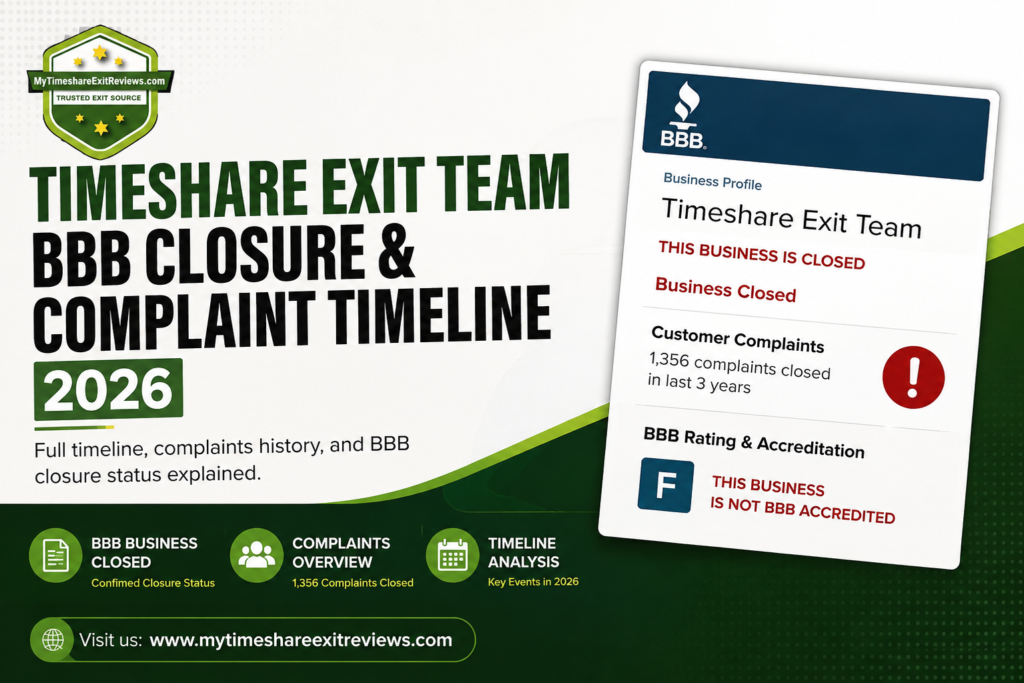
Timeshare Exit Team Review: Updated 2026
Timeshare Exit Team, legally Reed Hein & Associates LLC, closed its doors on December 31, 2021, after Washington’s Attorney General sued the company and a federal class action later put a $630 million judgment on the table. If you’re reading this Timeshare Exit Team review because someone in your family signed with them years ago, or because their name keeps surfacing next to the word “scam,” here’s the short version: the company isn’t taking new clients, several legal actions are still unresolved, and there’s a specific place to check if you’re owed money.
Below, we walk through what Timeshare Exit Team actually was, how the $4,000–$9,000 up-front model worked, why regulators stepped in, and what the current class action and refund process look like heading into the back half of 2026. We’ll also flag where the public record still has open questions, so you’re not left guessing.
Who Was Timeshare Exit Team?
Brandon Reed and Trevor Hein started the company in 2012 out of a small office in Kirkland, Washington. Both men had backgrounds in home-improvement sales, specifically rain gutters, before pivoting to timeshare cancellations. Reed Hein & Associates grew fast. By the late 2010s, the company operated out of roughly 30 U.S. locations plus a Canadian office in Ottawa, and it leaned hard into radio advertising to reach owners nationwide.
Two names did most of the heavy lifting on that advertising: Dave Ramsey and Steve Harvey. Ramsey’s endorsement carried particular weight because his audience already distrusted timeshares. He’d spent years telling listeners never to buy one in the first place. Recommending a company that promised to undo that mistake landed well, at least until the lawsuits started piling up.
The core facts:
- Legal name: Reed Hein & Associates LLC, doing business as Timeshare Exit Team
- Founded: 2012, Kirkland, Washington
- Founders/owners: Brandon Reed (CEO) and Trevor Hein
- Peak footprint: approximately 30 U.S. offices plus one Canadian location
- Marketing claim: more than 22,000 completed exits at its height, with company filings later referencing over 41,000 total exits and roughly 16,000 unresolved cases as of September 2021
- Current BBB status: Not accredited. The profile that once carried an A-range rating now shows the business as closed.
Timeshare Exit Team Shut Down: What Actually Happened
Reed Hein stopped operating on December 31, 2021. That date isn’t a rumor. It followed directly from a consent decree the company signed with the Washington State Attorney General’s office ten weeks earlier.
Here’s the sequence: Washington’s AG (Bob Ferguson at the time; the office is now held by Nick Brown) filed a consumer protection lawsuit against Reed Hein & Associates, Brandon Reed, Trevor Hein, and two related entities (Makaymax Inc. and Hein & Sons Industries) in King County Superior Court on February 4, 2020. The case alleged the company advertised a 100% money-back guarantee it had no real intention of honoring, and that it charged large up-front fees for a service it often couldn’t deliver.
On September 28, 2021, both sides entered a consent decree. Reed Hein agreed to stop operating in its existing form, pay $2.61 million toward consumer restitution, and submit to ongoing state oversight. The company wound down its remaining offices by year-end. So when people ask whether Timeshare Exit Team shut down because of one bad lawsuit or because the whole business model collapsed, the honest answer is both. The settlement forced the closure; the closure confirmed what the lawsuit alleged.
If you paid Reed Hein and live in Washington state, there’s an active claims process. The AG’s office hired Kurtzman Carlson Consultants (KCC) to administer refunds through timeshareexitteamsettlement.com. Eligible former clients need to complete and return a survey about their experience, either by mail or to Info@TimeShareExitTeamSettlment.com, to be considered. Outside Washington, this particular refund path doesn’t apply, though the federal class action below might.
How the Reed Hein Process Worked
Setting aside the legal fallout, the actual service followed a fairly standard playbook for the industry at the time:
- Free consultation. A 60–90 minute call or in-person meeting where a sales rep reviewed the timeshare contract and pitched the exit service.
- Up-front payment. Clients paid $4,000 to $9,000 before any work began, and more if a mortgage balance remained on the timeshare. Some later complaints cited fees running as high as $72,000 for complex cases.
- Stop-pay instruction. Reed Hein frequently told owners to stop paying maintenance fees while the company “negotiated.” That advice is where a lot of the credit damage in complaints traces back to.
- Demand letters and negotiation. Staff or referred attorneys sent letters to the resort developer pushing for a deed-back, surrender, or negotiated release.
- Resolution or refund claim. If no exit materialized within the guarantee window (never less than 18 months per the company’s own contract language), clients could, in theory, request a refund.
That last step is where things broke down for a lot of owners. The guarantee had enough carve-outs, including missed response deadlines, undisclosed liens, and refusing an offered exit, that Reed Hein could deny a claim in almost any circumstance, according to the federal complaint later filed against the company.
The $630 Million Question: Inside the Adolph Class Action
The single biggest legal development in this story doesn’t come from Washington state. It comes from a federal courtroom.
In October 2021, former clients Brian and Kerri Adolph filed a class-action complaint against Reed Hein in the U.S. District Court for the Western District of Washington. They’d bought a Wyndham timeshare in 2019 and paid Reed Hein roughly $14,486 in March 2020 for an exit that never came, according to court filings. Their attorneys at Albert Law PLLC built the case around the same core allegation as the state’s: a marketed guarantee that the company had no consistent ability to honor.
The court certified the case as a class action on October 25, 2022, covering an estimated 35,000 consumers nationwide. The number that’s turned heads since is $630.19 million, a judgment figure that reportedly combined direct damages with treble damages tied to 14 separate arbitration awards against the company. It’s one of the largest dollar figures ever attached to a timeshare exit case.
Here’s the part that matters if you’re a class member waiting on a check: Reed Hein’s insurer, General Casualty Company of Wisconsin, has formally challenged that $630 million figure in federal court, arguing it was calculated by a plaintiffs’ expert without the relevant background to support the number. As of the most recent public updates, that insurance dispute is heading toward trial, with a court date referenced for March 2026.
No money had reportedly reached class members as of the latest update available. If you believe you’re part of this class, the case-tracking site at reedheinclass.wordpress.com and PACER records under Adolph et al. v. Reed Hein & Associates are the two places to check status directly, rather than relying on secondhand summaries.
Is Timeshare Exit Team a Scam?
“Scam” is a strong word, and it matters whether you mean it legally or colloquially. Legally, no criminal fraud conviction has been reported against Reed Hein & Associates or its founders. What does exist is a state consumer-protection settlement, a certified federal class action with a nine-figure judgment figure attached, and thousands of individual complaints describing the same pattern: money collected up front, promised timelines missed by years, and refund requests denied under contract fine print.
Whether you call that a scam or “aggressive, unsustainable business practices that regulators eventually caught up with” is partly semantic. The practical answer for anyone researching this today is the same either way: the company that took your money in 2016 or 2019 no longer exists in its original form, the refund guarantee it sold you was never backed by escrow, and pursuing what you’re owed now runs through legal claims processes rather than a phone call to customer service.
Dave Ramsey’s Endorsement and the Fallout
For nearly six years, Ramsey’s radio show funneled a significant volume of business to Reed Hein. According to a 2023 lawsuit filed by 17 former Reed Hein customers, Ramsey and his company, The Lampo Group, were paid roughly $450,000 a month between 2015 and 2021, about $30 million total, to promote Timeshare Exit Team on air. The same suit claims Reed Hein collected $70 million in fees from customers who came in through Ramsey’s referrals, and that Ramsey kept endorsing the company even after complaints and legal flags started accumulating.
The plaintiffs sought more than $150 million in damages, alleging Ramsey’s platform lent false credibility to a service his own listeners ended up regretting. It’s a useful reminder for anyone shopping for a timeshare exit company today: a celebrity endorsement, however sincere, isn’t a substitute for checking the company’s actual complaint history yourself.
Pros and Cons
| Pros | Cons |
|---|---|
| Strong early brand recognition from national radio ads | Fully closed since December 31, 2021; not accepting new clients |
| Contract included money-back language | No escrow. Funds went directly to the company, so the “guarantee” was only as solid as its balance sheet |
| Offered a defined, documented process (consultation, contract review, negotiation) | $2.61M Washington AG settlement and a certified federal class action tied to the business |
| Some clients did report successful exits over the years | Common complaint pattern: stop-pay advice that damaged credit, followed by denied refund claims |
What to Do If You Paid Timeshare Exit Team
If you’re a former client and you’re not sure where things stand, three steps matter more than anything else:
- Check the Washington refund process at timeshareexitteamsettlement.com if you’re a Washington resident. That’s the direct channel tied to the AG’s settlement.
- Check your class membership status for the Adolph v. Reed Hein federal case through PACER or the case-tracking site, especially before the insurer dispute resolves and any distribution timeline becomes clearer.
- Pull your credit report if you were told to stop paying maintenance fees. Damage from that advice sometimes shows up as collections or a lien well after the fact, and disputing it earlier is easier than disputing it years later.
Choosing a Legitimate Exit Path Now
The single structural fix that would have protected Reed Hein’s clients, and every other exit company’s clients who’ve filed similar complaints, is escrow. If your payment sits with a licensed third party until the exit is actually delivered, a company’s guarantee doesn’t depend on whether that company still exists in eighteen months. It depends on whether the job got done.
That’s the standard we hold every company on this site to before recommending them. Before you sign anything with any timeshare exit company in 2026, ask three questions. Does the fee sit in escrow? Who holds it? What specific event releases it? If the answer is vague, or if you’re asked to pay everything up front with no third party involved, that’s the same setup that led to this entire situation.
Frequently Asked Questions
Is Timeshare Exit Team still in business in 2026?
No. Reed Hein & Associates, doing business as Timeshare Exit Team, closed on December 31, 2021, following a consent decree with the Washington Attorney General. The BBB profile now shows the business as closed and not accredited.
Why did Timeshare Exit Team shut down?
The company signed a consent decree with Washington’s Attorney General on September 28, 2021, resolving a lawsuit that alleged deceptive advertising of a 100% money-back guarantee. The settlement required a $2.61 million payment and an end to the company’s existing operations, and it closed by year-end.
Is Timeshare Exit Team a scam, or was it just a failed business?
There’s no reported criminal fraud conviction, but the company settled a state consumer-protection lawsuit and faces a certified federal class action with a $630.19 million judgment figure attached. Whether that meets your personal definition of “scam” or not, the practical risk to consumers was the same either way. Money was paid up front with no escrow protection.
How do I know if I’m owed a refund from Timeshare Exit Team?
Washington residents should start at timeshareexitteamsettlement.com, the KCC-administered claims site tied to the AG settlement. For the broader federal class action, check your status through the Adolph v. Reed Hein case records or consult an attorney, since the insurer’s dispute over the $630 million figure is still working through the courts.
What happened with Dave Ramsey and Timeshare Exit Team?
Ramsey promoted the company on his radio show from 2015 to 2021 and was reportedly paid around $30 million over that period. In 2023, In 2023, seventeen former Reed Hein customers filed a $150 million-plus lawsuit against Ramsey and The Lampo Group, arguing his endorsement gave the company credibility it didn’t deserve given the complaints and legal trouble already piling up against it.
What should you actually look for in a timeshare exit company?
Prioritize escrow-based payment, with your fee held by a third party until the exit is delivered. Look for a written, dated process with named steps, verifiable BBB and Trustpilot history with recent reviews, and a refund policy without contract loopholes that let the company deny nearly every claim.
Final Verdict
Timeshare Exit Team’s story is a case study in what happens when a company’s marketing outpaces its ability to deliver: fast growth, celebrity endorsements, and a guarantee that worked great in ad copy but collapsed under actual claim volume. The $2.61 million state settlement and the $630 million federal judgment figure aren’t just numbers. They’re the difference between what the company promised and what it paid out.
If you’re a former client, your next move is a records check, not a phone call to an office that no longer exists. If you’re shopping for a timeshare exit company today, treat escrow as non-negotiable, and use this company’s history as the exact checklist of what to avoid.