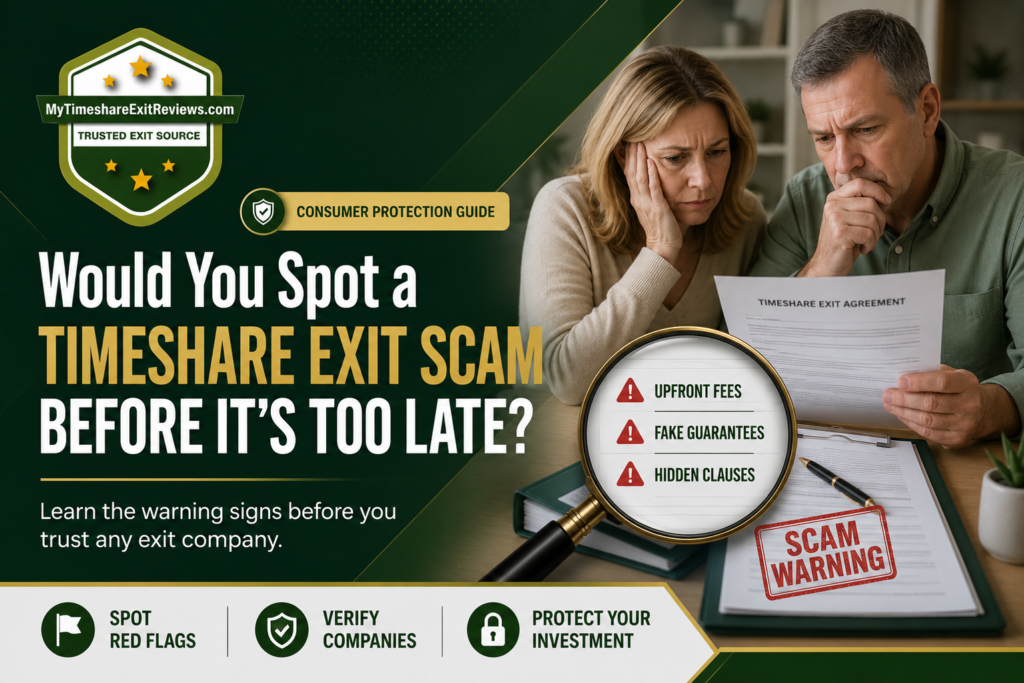
How Bad Are Timeshare Exit Scams in 2026?
Bad, and getting worse.
The FTC logged more than 4,200 timeshare-related complaints in the last twelve months alone . AARP’s fraud unit has flagged timeshare exit fraud as one of the top-three growing scams targeting Americans over 55, right alongside romance scams and fake IRS calls .
Here’s what we’re seeing on the ground for this 2026 refresh. Owners are being contacted through channels the old scam playbook never touched: text messages that look like they came from your resort, DMs on Facebook groups for timeshare owners, cold emails that reference your actual contract number. The scammers have gotten better. Their websites look real. Their intake reps sound professional. And they know exactly which words to say to make a worried owner feel like they’ve finally found the way out.
We’ve been reviewing timeshare exit companies since 2018. In that time, we’ve seen owners hand over anywhere from $3,000 to $28,000 to companies that either did nothing, disappeared entirely, or “cancelled” contracts in ways that got the owner sued by the developer later. The average loss on a full-blown timeshare exit scam is somewhere between $5,000 and $9,000 .
The good news is that most of these scams follow a small set of patterns. Once you know what to look for, they’re much easier to spot than they used to be.
How Timeshare Exit Scams Actually Work
Before we get to the 12 red flags, it helps to understand the actual playbook. Almost every timeshare exit scam runs through the same three phases.
Phase 1 — Contact.
The scammer reaches out through some channel that feels legitimate. Sometimes it’s a cold call claiming they represent “your resort’s cancellation department.” Sometimes it’s a text that references your specific developer. Sometimes it’s a Facebook ad targeting timeshare owner interest groups. The message is always the same: you qualify for a limited-time exit program, and you need to act fast.
Phase 2 — The Pitch.
You get connected to an intake specialist who sounds like they know the industry. They ask about your developer, your maintenance fee amount, and when you bought. Then they lay out a program that sounds almost too good — “guaranteed” cancellation, sometimes with a refund of past maintenance fees, wrapped up in 60 to 90 days. The cost is usually $4,000 to $9,000, paid upfront. Sometimes they offer a “discount” if you sign today.
Phase 3 — Disappearance or Stalling.
You pay. For the first month, you get updates that sound plausible. Then updates slow down. Emails go unanswered. The phone number that was so easy to reach starts sending you to voicemail. By month six, the company has either gone silent completely, closed down and rebranded under a new name, or is stringing you along with “the developer is being difficult” messages that never end.
The best timeshare scam warning signs all show up in Phase 2 before you pay. That’s what the 12 red flags below focus on.
The 12 Red Flags — Every Warning Sign, Ranked
We’ve ordered these roughly by how strong the warning signal is. If a company hits any of the top three, we recommend walking away immediately. Two or more of any of them and you should be very, very cautious.
#1 They want the full payment upfront with no escrow
This is number one for a reason. If a company is asking you to wire, Zelle, or credit-card $5,000 into an account they control, with nothing sitting in escrow, the risk of that money vanishing is enormous. Legitimate exit companies use third-party escrow; your money sits with an independent escrow agent and is only released to the exit company after specific case milestones are hit.
There is no legitimate reason a real exit company needs to have full custody of your money on day one. None. If you push back and they tell you it’s “how we cover our attorney costs upfront,” that’s the same excuse the last three scams gave.
#2 They promise your case will be done in 30 to 90 days
Real timeshare exits take 9 to 24 months on average. Even the fastest legitimate cases involving small developers with existing deed-back programs rarely finish in under six months. A company promising 30, 60, or 90 days either doesn’t understand the industry or is lying to you.
Ask a specific follow-up: “What exactly gets done in 30 days that terminates my contract?” A real advocate will give you a nuanced answer about developer notification and negotiation timelines. A scammer will get vague, defensive, or aggressive.
#3 They contacted you first — and knew your specific timeshare details
You did not sign up to be contacted. You did not fill out a form. And yet somehow a rep is on the phone quoting your developer name, your resort location, and sometimes even your maintenance fee amount.
This is one of the strongest timeshare scam warning signs in 2026. Legitimate exit companies do not cold-call timeshare owners with their contract details. That data is being scraped from public court records, purchased from broker lists, or in some cases leaked from previous exit-company breaches. The moment somebody says “we saw you’re a Wyndham owner in Orlando and we can help you get out,” hang up.
#4 They’re pressuring you to sign the same day
“This offer expires at midnight.”We can only take 10 more clients this month.”Our attorney’s schedule opens up tomorrow; after that, prices go up.”
Every one of those is a manufactured urgency tactic pulled straight out of the timeshare sales playbook. Ironically, the same pressure that got people into their timeshare is now being used to scam them out of it. Any timeshare exit that legitimately requires a decision within 24 hours is not something you want to be signing anyway.
#5 They can’t (or won’t) put the terms in writing before payment
You ask for a contract. They send you a one-page “service agreement.” You ask for the refund clause language. They tell you it’s covered in the terms and to just call if there’s ever an issue. You ask what specifically triggers the “100% money-back guarantee.” They dodge.
Every one of those responses is a red flag. A real exit company will send you a multi-page agreement that spells out fee structure, timeline, refund conditions, and dispute-resolution process. You should be able to read the entire refund clause before you sign or pay a dollar.
#6 Their “100% money-back guarantee” has undefined trigger conditions
This one is subtle. Almost every exit company, legitimate and otherwise, advertises a 100% money-back guarantee. The scam is in the fine print. What actually counts as failure? Does the guarantee kick in if the case takes longer than promised? Only if they formally “give up”? Only if you follow every one of their instructions perfectly for the entire case?
If you ask what specifically triggers the refund and the answer is anything other than a clear, written condition, treat it as no guarantee at all.
#7 They tell you to stop paying maintenance fees immediately
This is a dangerous piece of advice that’s become a common scam signal. Yes, in some legitimate exit strategies, there’s a point where an advocate may recommend stopping payments as part of a broader plan, but that decision comes after case review, in writing, with your informed consent. It is never a first-call recommendation.
If someone tells you to stop paying on the intake call, before you’ve signed anything, before they’ve seen your contract, they are either incompetent or setting you up. Stopping maintenance fees prematurely can wreck your credit, trigger foreclosure, and make the exit process substantially harder later.
#8 They claim to have a “special relationship” with your developer
“We work directly with Wyndham.”We have an agreement with Diamond Resorts.”The resort has authorized us to handle cancellations.”
None of the major developers have authorized third-party exit companies to cancel contracts on their behalf. Wyndham, Diamond, Westgate, Bluegreen, Marriott, Hilton, Holiday Inn – every one of them has publicly stated they do not work with, endorse, or partner with outside exit firms . Any company claiming otherwise is lying about the most basic fact of the industry.
#9 Their address is a virtual office, PO Box, or shared workspace
Look up the physical address on Google Maps and Street View. If it turns out to be a Regus, WeWork, UPS Store, or an empty strip-mall unit with no signage, you’re not dealing with an established company. This isn’t a definitive sign; some legitimate small firms do use shared workspaces, but combined with any of the other red flags on this list, it should push you firmly toward no.
Legitimate exit companies with hundreds of active cases have real offices. You should be able to find photos, employee LinkedIn profiles that reference that address, and (in some cases) news coverage or industry directory listings.
#10 They have no BBB profile, or a very new one with all 5-star reviews
Check the Better Business Bureau. Every legitimate exit company will have a profile that’s at least a few years old, with a mix of complaints and resolutions. If a company has:
- No BBB profile at all
- A BBB profile that’s less than 12 months old
- A BBB profile with only 5-star reviews and no complaints
- A BBB profile under a slightly different company name than what they told you
…any of those patterns is a warning. The first is amateur. The second is a rebranded firm. The third is either fake or too new to trust. The fourth is a company hiding from complaints.
#11 They keep changing the price, adding “case complications,” or introducing new fees
You get quoted $4,900 on the first call. You sign the agreement — the number is $5,200 because of “processing.” Three months in, you get emails saying your case “needs additional advocacy” for another $2,400. Six months in, there’s a “credit repair add-on” for $1,800 you never asked for.
Legitimate exit companies charge one flat fee that covers the entire case. Scammers escalate. Once you’ve paid the first amount, they know you’re psychologically invested in seeing it through, and they use that to extract more.
#12 Their online reviews are either all glowing or clearly copy-pasted
Read the reviews carefully — not just the star ratings. Real reviews from real customers mention specific developers, specific timeline details, specific case advocate names, and specific outcomes. Fake reviews use vague language: “great company,””highly recommend,””professional service.” They’re often posted in clusters (five reviews the same week, then nothing for months). They’re sometimes written in the same voice across “different” reviewers.
Cross-check reviews across BBB, Trustpilot, Google Business, and Reddit. If a company has 4.9 stars on their own website but no meaningful presence anywhere else — that’s a manufactured reputation.
Get the Free Scam-Check Checklist
Download the printable one-page version of these 12 red flags. Take it with you into any exit-company consultation call. If they hit two or more, hang up.
[ Download the Free Scam-Check Checklist → ] (here)
The 5 Most Common Types of Timeshare Fraud in 2026
Not every scam follows the same script. Here are the five variations we’ve seen most this year.
The Fake Exit Company.
The classic. A company with a professional website, an intake team, and a plausible pitch. You pay $5,000 to $9,000 upfront. They do nothing essentially. Sometimes they send one letter to the developer to create the illusion of activity. Six months later, they’ve closed down or gone silent.
The Rebranded Repeat Offender.
Same operators, new company name. When enough BBB complaints stack up under one name, they close the LLC, open a new one, buy a new domain, and start over. If a company’s website is less than a year old but the team behind it “has 15 years of experience,” look up the individuals on LinkedIn and cross-check against defunct exit-company names.
The Fake Resale Scam.
A company contacts you claiming they have a buyer lined up for your timeshare; you just need to pay a $2,000 to $5,000 “closing fee,””title transfer fee,” or “escrow fee” to complete the sale. There is no buyer. The fee is the scam.
The Fake Refund / Recovery Scam (the double-tap).
This one specifically targets owners who’ve already been scammed once. Someone contacts you claiming they can recover the money you lost to the previous exit company for a fee. Sometimes they even pose as a government agency or a class-action lawyer. If you’ve been scammed and someone reaches out unsolicited offering to help you get your money back, they’re almost certainly the second scam.
The Deceptive Deed-Transfer Scheme.
A company “cancels” your timeshare by transferring the deed to a shell LLC, often based in Nevada or Wyoming, that then stops paying maintenance fees. Legally, in most cases, the developer can still come after you. Some owners have been sued by their developer years after their “successful” exit for exactly this reason. If a company’s cancellation strategy involves transferring your deed to an entity you’ve never heard of, get an independent attorney’s opinion before signing
How to Verify a Real Timeshare Exit Company
Verification takes about 20 minutes and saves people thousands of dollars every day.
Check the BBB profile.
Look for accreditation, the age of the profile, the number of complaints filed, and most importantly, the pattern of the complaints. A few complaints about timeline is normal in this industry. A pattern of “took my money and disappeared” is not.
Check the state business registry.
For US-based exit companies, look up the company in the Secretary of State registry of the state they claim to be based in. Verify the registration date matches how long they claim to have been in business.
Check individual advocates on LinkedIn.
Real exit companies have real staff. You should be able to find at least 3-5 employees on LinkedIn who list that company as their current employer.
Check court records via PACER or state court websites.
Search for the company’s name in federal and state court databases. Legitimate exit companies will have some litigation history — developers regularly sue them. Scam companies often show up in consumer fraud cases as defendants, or don’t appear anywhere.
Read our independent reviews.
We maintain updated 2026 reviews of the major exit companies, including Wesley Financial Group, Timeshare Compliance, Resort Advisory Group, and others in our Best Timeshare Cancellation Companies guide.
Ask us directly. If you’re being pitched by a company you don’t see on our recommended list, use the Get Info form on any page of this site. We’ll tell you honestly whether we’ve seen the company before, whether they’ve been flagged for issues, and whether the offer you’re being made lines up with industry norms.
What to Do If You’ve Already Been Scammed
If you’re reading this after already paying an exit company that has since disappeared or stopped responding, you have options. Not great ones, but real ones.
Move fast on chargebacks.
If you paid by credit card within the last 60 to 120 days, file a chargeback with your card issuer immediately. Cite non-delivery of services. Credit card chargebacks have the highest recovery rate of any single option. Wire transfers, Zelle, and cashier’s check payments have almost zero recovery rate — file the report anyway, but temper expectations.
Document everything.
Emails, texts, contracts, call logs, any voicemails you have. Save it all. You’ll need it for reports and potential legal action.
File with the FTC.
ReportFraud.ftc.gov. This doesn’t get your money back directly, but it feeds into FTC enforcement actions and can prevent the same operators from scamming others.
File with your state Attorney General.
State AGs have jurisdiction over consumer fraud within their borders. Some state AG offices have specifically pursued timeshare exit fraud cases.
File with the BBB.
BBB complaints occasionally lead to mediated resolutions. More often, they warn the next potential victim.
Consult a consumer protection attorney.
Some attorneys will take clear-cut exit-company fraud cases on contingency, especially if there are multiple victims and evidence of a pattern.
Do not pay a “recovery service” to help you get your money back.
As noted above, this is one of the most common secondary scams targeting people who’ve already been defrauded once. Legitimate recovery happens through your card issuer, your bank, government agencies, or a licensed attorney, not through an unsolicited phone call from someone who “specializes in helping scam victims.”
How to Report a Timeshare Exit Scam
Even if you didn’t lose money, even if you just got the call, reporting matters. Enforcement agencies build cases on volume.
Report to:
- Federal Trade Commission (FTC): reportfraud.ftc.gov
- Consumer Financial Protection Bureau (CFPB): consumerfinance.gov/complaint (if you were charged fees on a financial product)
- State Attorney General: search “[Your State] attorney general consumer complaint”
- Better Business Bureau: bbb.org/file-a-complaint
- FBI Internet Crime Complaint Centre (IC3): ic3.gov (especially for wire transfer fraud)
- AARP Fraud Watch Network Helpline: 877-908-3360 (particularly if the victim is over 60)
Report to all of them if you have the time. The more entries a scam operator has across multiple databases, the faster enforcement moves.
Frequently Asked Questions
How can I tell if a timeshare exit company is a scam?
The clearest scam indicators are: they want full payment upfront with no escrow protection, they promise cancellation in under 90 days, they contacted you unsolicited with your specific timeshare details, they pressure you to sign the same day, or they refuse to put refund conditions in writing before you pay. Any two of these signs together mean walk away. See the full 12 red flags list above.
Are all timeshare exit companies scams?
No. Legitimate timeshare exit companies exist and do help owners cancel real contracts. What separates them from scam operations is that real exit companies use third-party escrow so your money is protected until case milestones are met, put full terms in writing before payment, quote realistic 12 to 24 month timelines, and have verifiable BBB profiles, court records, and staff.
Can I get my money back if I’ve been scammed by a timeshare exit company?
Sometimes. Your best chance is a credit card chargeback filed within 60 to 120 days of payment. Wire transfers, Zelle, and cashier’s checks are much harder to recover. File reports with the FTC, your state Attorney General, and the BBB; regardless, enforcement actions occasionally result in restitution. A consumer protection attorney may take clear-cut fraud cases on contingency.
Why do timeshare exit scams target older owners specifically?
Older owners are the sweet spot for these scammers, and it’s not accidental. People over 55 have usually paid their timeshare off, which means there’s more money to protect. They tend to make decisions over the phone rather than after 40 minutes of Googling. And they came up in an era where a professional-sounding voice on the other end of a call was, most of the time, actually a professional. AARP has flagged timeshare exit fraud as one of the top three scams hitting Americans over 55 this year.
Is it a scam if a company contacts me first about my timeshare?
Almost always, yes. Legitimate exit companies do not cold-call, text, or email timeshare owners with their specific contract details. That information is either scraped from public records, purchased from broker lists, or leaked from prior data breaches. Unsolicited contact combined with knowledge of your specific developer and resort is one of the strongest 2026 warning signs.
What’s the fastest a real timeshare exit takes?
Legitimate cases typically take 9 to 24 months. The fastest cases with a small developer, paid-off contract, and existing deed-back program can occasionally finish in 6 to 9 months. Any promise of 30, 60, or 90 days is not realistic and is one of the most reliable scam indicators in this industry.
Should I ever pay a timeshare exit company by wire transfer?
No. Wire transfers and Zelle payments are almost impossible to reverse if the company disappears. Legitimate exit companies use third-party escrow accounts, credit card payments, or (in some cases) financed payment plans through independent lenders. Any request for wire transfer or Zelle to a company-controlled account is a strong signal to stop.
How do I know if a “recovery service” contacting me about a prior scam is legitimate?
You don’t, and it’s rarely legitimate. Unsolicited recovery services targeting prior scam victims are one of the fastest-growing secondary scams in 2026. Real recovery happens through your credit card issuer, your bank, state Attorney General offices, the FTC, or a licensed attorney you contact directly. If someone reaches out to you first offering to recover money you lost, treat it as a second scam.
Get Your Free 2026 Scam-Check Checklist
One printable page. Twelve red flags. Take it with you into every exit-company consultation. If a company hits two or more of the items on the checklist, walk away no matter how good the pitch sounds.
[ Download the Free Scam-Check Checklist → ] (here)
Sources & Methodology
This guide draws on:
- FTC Consumer Sentinel data on timeshare-related complaints
- AARP Fraud Watch Network reports on scams targeting Americans over 55
- BBB Scam Tracker data on timeshare exit companies
- Public court records for timeshare exit companies via PACER and state court databases
- Owner interviews and intake calls conducted by our editorial team
- Reddit r/timeshare community discussions cross-referenced against BBB and Trustpilot records.
mytimeshareexitreviews.com is an independent consumer research platform. We do not accept payment from timeshare exit companies for coverage or rankings.