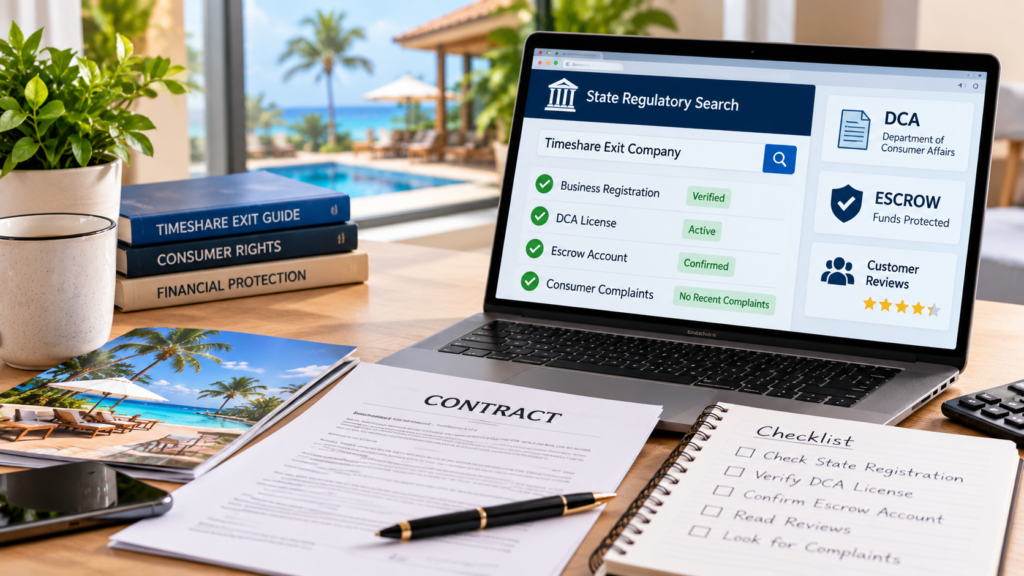
Why Fake Exit Companies Are Getting Harder to Catch
Most owners who lose money to an exit scam aren’t careless. They’re tired.
They’ve watched maintenance fees climb year after year. They’ve called the resort and gotten nowhere. Then the phone rings, or an ad shows up in their feed, and suddenly there’s someone on the line who seems to get it.
That moment is exactly what a fake timeshare exit company is built for.
The operations have changed, too. Years ago, a scam outfit usually looked like one. Thin website. A cell number. A rep who couldn’t answer basic questions. These days the sites are polished, the intake reps are calm and well scripted, and some groups borrow names that are nearly identical to real firms. FINRA has warned that some fraudsters even send owners to fake banking websites showing escrow balances that don’t exist.
So asking “does this company look professional?” won’t protect you. Most of them do. The better question is simpler: can this company prove what it says before I send a dollar?
That’s what this guide is about. You’ll get the warning signs that show up on the very first call, a step-by-step way to check any firm yourself, and a plan for what to do if you’ve already paid.
| Quick Answer
A fake exit company usually asks for a large payment upfront (by wire, Zelle, or an “escrow” it controls), promises a guaranteed cancellation in weeks, contacted you first, and can’t show a verifiable state registration, licensed attorney, or independent escrow agent. If two or more of those show up, stop and verify before you pay anything. |
How These Operations Work Behind the Website
Nearly every fake timeshare exit company we’ve looked into follows the same three moves. Once you know the pattern, it’s much easier to notice when you’re standing in the middle of it.
Move 1: Borrowed Credibility.
The company borrows trust it hasn’t earned. Maybe its name is one word off from a well-known firm. Maybe the logo looks a lot like your resort’s. Maybe the rep says they “work with” your developer. Some sites use stock photos of an office and list attorneys who, when you search for them, don’t seem to exist.
Move 2: The Easy Yes.
Next comes the pitch. The rep asks a handful of surface questions about your resort and your fees, then tells you your case looks “really strong.” There’s usually a guarantee, a short timeline, and a price anywhere from a few thousand dollars to five figures. Often there’s a discount if you sign today.
Move 3: The Slow Fade.
After you pay, updates come quickly for a few weeks. Then they slow down. Then the excuses arrive: the developer is stalling, the attorney is backed up, your case needs “additional advocacy” for an extra fee. Eventually the calls go to voicemail, or the same people resurface under a new company name. One consumer advocate told WPXI’s 11 Investigates team that an operator can keep this going for six to eight months and collect a fortune before anyone catches on.
Timeshare Exit Company Red Flags You Can Catch on the First Call
You don’t need a law degree to spot most of these. You need a notepad and a willingness to ask direct questions. Below are the timeshare exit company red flags we take most seriously, in rough order of how loudly they should ring.
#1 They want payment before you’ve seen the full contract
If someone asks for your card number or a wire before you’ve received the complete agreement, stop right there. A real firm sends the contract first, gives you time to read it, and doesn’t get defensive when you say you want someone else to look it over.
#2 The “escrow” is one they picked
Escrow is supposed to protect you. Your money sits with an independent third party and is only released when specific milestones are met. That’s why timeshare exit companies with escrow tend to be safer bets. Scammers know owners have heard this, so they offer escrow too, just not a real one. The account might belong to an affiliated business, or the “escrow portal” might be a website they built themselves. If you can’t confirm on your own that the agent is licensed and unrelated to the company, treat it as no escrow at all.
#3 They guarantee a result on a short clock
Nobody can promise what your developer will do. Legitimate exits commonly take many months, and some run past a year. A pledge of 30, 60, or 90 days is a sales line, not a plan.
#4 They reached out to you first
A call, text, or Facebook message that already knows your resort’s name is one of the oldest openers in the book. Both Club Wyndham and Hilton Grand Vacations warn their owners about third parties that make first contact. Hang up, write down the name, and do your own digging.
#5 They claim a partnership with your resort
The big developers have said publicly that they don’t endorse outside exit firms. A rep who tells you “we work directly with your resort” is either confused or lying. Neither one should be handling your money.
#6 They can’t name your attorney
Lots of firms say lawyers handle every case. Ask for the attorney’s full name and state bar number. If the answer is fuzzy, or the “legal team” changes every time you call, you have your answer. Wyndham’s own scam guidance flags a firm’s refusal to name your attorney as a warning sign.
#7 They tell you to stop paying your resort immediately
Being told to stop paying maintenance fees on the first call, before anyone has read your contract, can wreck your credit and push you toward foreclosure. Some outfits even count a foreclosure as a “successful exit.” It isn’t one. It’s a default with your name on it.
#8 The price keeps climbing
You’re quoted one number on the phone, a bigger one at signing, and then “case complications” add more later. Honest firms quote a flat fee and stick to it. For a sense of what’s normal, our breakdown of timeshare exit cost lays out typical ranges.
| Not Sure About a Company That Contacted You?
Tell us the company name and what they offered. We’ll let you know if we’ve seen complaints about them and whether their terms line up with what reputable firms charge. It’s free, and there’s no obligation. [ Book Your Free Consultation → ] Claim your free timeshare exit consultation here. |
How to Verify a Timeshare Exit Company in 7 Steps
Spotting warning signs is half the job. The other half is proving a firm is real. Here’s how to verify a timeshare exit company in about 30 minutes using free public tools. Go in order and keep notes as you work.
Step 1: Search the exact legal name with “scam” and “complaints”
Put the company’s full name in quotes and add words like scam, fraud, complaints, and lawsuit. Then repeat the search with the names of the people you spoke to. Look past page one. Shady firms are good at pushing their own glowing pages to the top.
Step 2: Confirm the state business registration
Every real company is registered somewhere. Look it up on the Secretary of State website for the state named in its paperwork, and check the formation date. If a firm brags about fifteen years of experience but its LLC was created eight months ago, ask why. FINRA recommends this exact check.
Step 3: Read the BBB file, not just the grade
A letter grade tells you very little. Open the complaints and read how each one was handled. A few gripes about timelines are normal in this industry. A pattern of “took my money and vanished” is not. While you’re there, search the BBB Scam Tracker, where people report calls from suspected fraudsters.
Step 4: Check the attorney with the state bar
If a lawyer is supposedly involved, every state bar has a free online lookup. Make sure the attorney is licensed, active, and free of public discipline. Then call that attorney’s office on a number you found yourself and ask if they’re actually handling your file.
Step 5: Confirm the escrow agent independently
Get the escrow company’s name and research it separately. Is it licensed? Does it have a real address and a history that has nothing to do with the exit firm? Call it directly. Never trust a login link or a balance screen the exit company sent you. Spoofed escrow portals are one of the easiest tricks a fake timeshare exit company can pull.
Step 6: Call your resort on a number you look up
Use the number on your official statement or the developer’s own website. Ask whether they know the company and whether they offer a deed-back or surrender program. Many developers do, and some charge little or nothing. That single call might save you the entire fee. Our guide on how to get out of a timeshare walks through these direct options, and we also cover resort specific paths such as Holiday Inn and Vacation Village.
Step 7: Read what “success” means in the contract
Before you sign, find the paragraph that defines a finished case and the one that explains refunds. Does a foreclosure count as a success? Does the money back promise only apply if you follow every instruction to the letter? If those terms are vague, the guarantee is worth very little.
Real vs. Fake at a Glance
| Factor | Legitimate Company | Fake Company |
|---|---|---|
| First contact | You reach out to them | They call, text, or message you |
| Payment | Credit card or verified independent escrow, after the contract | Wire, Zelle, crypto, gift cards, or their own “escrow” |
| Timeline | Realistic, often many months | 30 to 90 days, guaranteed |
| Attorney | Named, licensed, verifiable | A vague “legal team” |
| Fees | Flat and in writing | Keep rising after you sign |
| Public records | Years of registration and BBB history | New LLC, missing or recycled history |
| Resort relationship | Doesn’t claim one | Says it “works with” your developer |
If you’d rather start with firms that have already been vetted, our roundup of the best timeshare cancellation company options and our individual timeshare exit company reviews, including Wesley Financial Group and Timeshare Compliance, are a good place to begin. Still run the steps above yourself. A review is a starting point, not a substitute for your own homework.
How to Pay So Your Money Stays Protected
Even when a company checks out, how you pay matters. A few simple rules go a long way.
- Use a credit card when you can. A card dispute gives you a real path to recover money if the service is never delivered.
- Never wire money or send Zelle, crypto, or gift cards to an exit firm. Those payments are extremely hard to reverse.
- Use escrow only with an agent you verified yourself, not one the company introduced and vouched for.
- Never pay a “closing fee,” “release fee,” or “tax” to complete a sale you didn’t start. That’s one of the oldest resale tricks around.
- Keep copies of everything: contracts, receipts, emails, texts, and call notes.
Here’s a good gut check. A legitimate firm won’t object when you insist on a payment method that protects you. A fake timeshare exit company almost always will, and that resistance tells you how it plans to treat your money.
Already Paid? What to Do in the Next 48 Hours
If you’re reading this after sending money, take a breath, then move fast. Speed matters more than anything right now.
- Call your card issuer or bank. Dispute the charge as services not delivered. If you wired funds, ask the bank to attempt a recall today.
- Freeze your credit. If you shared your Social Security number, date of birth, or bank details, place a free credit freeze with Equifax, Experian, and TransUnion. It takes minutes and blocks new accounts in your name.
- Save every record. Contracts, emails, texts, call logs, and screenshots of the company’s website before it disappears.
- File a complaint everywhere it counts. Report the fraud to the FTC at ReportFraud.ftc.gov, your state Attorney General, your state or local Department of Consumer Affairs (DCA), and the BBB. If money moved by wire or online, add the FBI’s IC3. Each report helps investigators link cases together.
- Tell your resort. Let them know a third party may be contacting them in your name, and confirm your account is current.
One more warning, and it matters. After a loss, you may hear from someone offering to recover your money for a fee. They might claim to be a law firm, a government office, or a class action group. Very often it’s the same people, or someone who bought their victim list. This “recovery” pitch is among the most common timeshare exit scams out there. Real recovery happens through your bank, your card company, government agencies, or an attorney you find on your own.
Frequently Asked Questions
How can I tell if a timeshare exit company is fake?
A fake timeshare exit company usually shows several of these at once: a demand for upfront payment by wire or through a company controlled escrow, a guaranteed result on a short timeline, first contact that came from them, and no verifiable registration, attorney, or escrow agent. If two or more appear, stop and check before paying.
How do I verify a timeshare exit company is legitimate?
Search the company name with words like scam and complaints, confirm its Secretary of State registration, read its BBB complaint history, verify any attorney through the state bar, check the escrow agent independently, and call your resort on a number you look up yourself.
Are all timeshare exit companies scams?
No, Legitimate timeshare exit companies do exist. The good ones tend to look a little boring, honestly. You’ll get the full contract before anyone asks for money, and nobody will promise you a 60 day miracle. Your payment goes on a credit card or to an escrow agent you can call yourself. And when you look the company up with your state or the BBB, there’s an actual history to find.
Is it safe to pay a timeshare exit company upfront?
Only with protection. Pay by credit card after reading the full contract, or through an independent escrow agent you’ve verified on your own. Avoid wires, Zelle, crypto, and gift cards.
What should I do if I gave a fake company my personal information?
Freeze your credit with all three bureaus, watch your bank and card statements closely, change passwords on any accounts you shared, and file reports with the FTC and your state Attorney General.
Can my resort cancel my timeshare for free?
Sometimes. Many developers run deed-back, surrender, or hardship programs, and some cost little or nothing. Always ask the resort directly before hiring anyone.
Can a company get my past maintenance fees refunded?
Be very skeptical. Promises to refund years of fees, or to recover money lost in a previous scam, are a common hook and a frequent sign of fraud.
| Get a Free, No Pressure Second Opinion
Before you sign with anyone, talk to someone who isn’t trying to sell you an exit. We’ll look at the offer you received, flag anything that seems off, and point you toward timeshare cancellation options that fit your situation. [ Get Your Free Consultation → ] (here) |
Sources & Methodology
This guide draws on:
- FINRA Investor Insights on timeshare exit fraud and lookalike company names
- FTC consumer guidance on timeshare resale and exit scams
- BBB Scam Tracker data and the BBB study of consumers who reported problems with exit companies
- Club Wyndham and Hilton Grand Vacations owner fraud protection guidance
- WPXI 11 Investigates reporting on fraudulent timeshare cancellation companies
- ESET WeLiveSecurity research on fake buyer and recovery scams
- Our editorial team’s review of exit company contracts, BBB files, and owner complaints
mytimeshareexitreviews.com is an independent consumer research platform. We do not accept payment from timeshare exit firms for coverage or rankings.