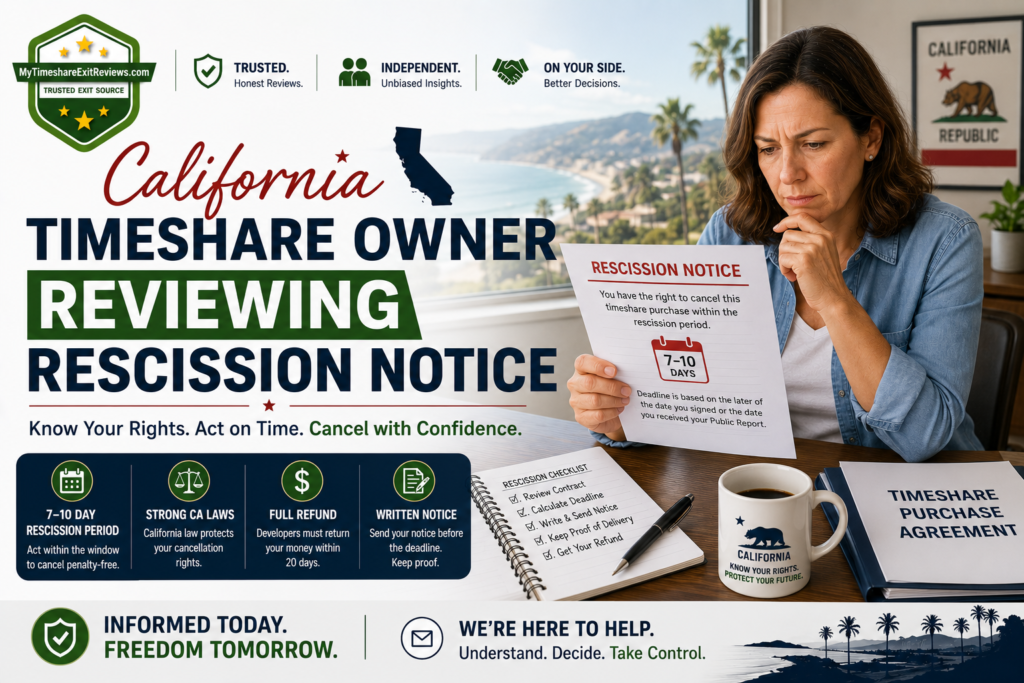
Yes, if you’re inside your seven calendar day rescission window under California Business & Professions Code § 11238, you can cancel timeshare California purchases for a full refund, no reason required, and no penalty. Miss that window and cancellation gets harder, but it isn’t off the table. The rest of this guide walks through both paths.
We’ve been comparing timeshare exit companies since 2018, and California is one of the more owner friendly states on paper, the seven day window, the mandatory escrow, the ban on waiving your rights but the presentations that get people into these contracts haven’t changed much. Below is what actually applies, in plain language, plus what to do if that first week already came and went.
Understanding California’s Rescission Period
Every timeshare buyer in California gets a built-in escape hatch, and almost nobody uses it correctly because almost nobody reads the paperwork the day they get home.
You have seven calendar days, not seven business days, counting from whichever comes later: the date you signed the purchase contract, or the date you actually received the developer’s public report. If your presentation happened somewhere other than the developer’s regular place of business. A hotel conference room, a timeshare expo, a booth at a mall that window stretches to ten calendar days instead of seven. Weekends count. Holidays count. The clock does not pause because the resort’s office is closed on Sunday.
Notice has to go out in writing before midnight of the last day. A phone call to the sales office doesn’t count, and a verbal “I want to cancel” to whoever answers the front desk line won’t hold up if the developer later claims they never received it. Mail, fax, or hand delivery to the address specified in your contract are the methods that count. If you mail it, California treats the postmark date as the delivery date so a letter dropped in the mailbox on day seven, postmarked that day, satisfies the deadline even if it physically arrives at the developer’s office a few days later.
Once that notice is delivered, the developer has to return every dollar you paid, and by law that refund has to move within 20 days of receiving your cancellation. This right can’t be signed away. Some contracts try to bury language suggesting you’ve waived it or shortened it, that language is unenforceable in California regardless of what the paperwork says.
The California Laws Working in Your Favor
California regulates timeshares more tightly than most states, and the framework comes from one statute: the Vacation Ownership and Time Share Act of 2004, codified at Business & Professions Code §§ 11210–11288. The California Department of Real Estate (DRE) not a delegated third party enforces it directly, which is unusual. Most states hand timeshare oversight to a general real estate board; California keeps it in house.
A few pieces of that statute matter more than the rest if you’re trying to get out of a contract:
The public report requirement
Before a developer can legally sell timeshare interests in California, the DRE has to issue a public report disclosing the resort’s finances, the maintenance fee structure, and the terms owners are actually agreeing to. That report is only valid for five years, and any material change to the property is supposed to trigger an update. If you never received one, or the one you got doesn’t match what you were told during the pitch, that’s a documentable problem.
Mandatory escrow during rescission
Under DRE rules, the money you pay during the presentation has to sit in escrow for the full seven day rescission window. It can’t go straight into the developer’s operating account. This is one of the clearer examples of California timeshare laws working in the buyer’s favor: if the developer never sets up proper escrow, that’s a violation the DRE can act on directly.
No deficiency judgments on the loan side
California Code of Civil Procedure § 580(b) blocks a lender from coming after you for the difference if your timeshare gets foreclosed and resold for less than you owed. Your credit still takes the hit, and the resort can still take the property back, but you generally won’t get chased for a separate cash judgment on top of it.
The $3,000 carve out
Business & Professions Code §§ 11211–11211.7 exempt timeshare interests priced at $3,000 or less from most of this regulatory framework, rescission rights included. Very few California timeshares fall under that number, but it’s worth checking your original purchase price if you’re unsure whether the statute applies to you at all.
Licensing for resale advance fees
If anyone asks you to pay an upfront fee to sell or resell your timeshare, § 10146 requires that person to be a licensed real estate broker who deposits the fee into a trust account not a personal or company operating account. Unlicensed resale “specialists” collecting advance fees are operating outside the law, full stop.
How to Cancel While You’re Still Inside Your Window
If you’re still inside your seven (or ten) day window, this is the entire process. No exit company, no attorney, no fee.
- Confirm your deadline. Pull the date you signed and the date you received the public report. Count seven calendar days from whichever is later. If the sale happened off-site, count ten.
- Write a short, direct cancellation letter. State your name, the contract number, the resort or developer’s name, and one sentence: that you are canceling under your right of rescission per California Business & Professions Code § 11238. You don’t need a reason, and you shouldn’t offer one a reason gives the developer something to argue with.
- Send it to the exact address in your contract. Every California timeshare contract has to list the cancellation address. Use that one, not the general customer service line. Certified mail with return receipt is the safest option because it creates a paper trail with a government stamped delivery date.
- Keep proof of everything. Copy the letter before you send it. Don’t toss the certified mail receipt or the tracking number, you’ll want both if the developer later claims they never got your letter. Once the signed delivery confirmation comes back, keep that too. It’s your proof the developer actually got the letter. If you fax it, save the transmission confirmation page.
- Follow up if you don’t hear back within two weeks. Developers are required to process the cancellation and return your money within 20 days of receiving notice. If that window closes with no refund and no communication, your next call is the California DRE, not a second letter.
- Watch your statements. Confirm the refund actually posts, and confirm no maintenance fee or loan payment gets pulled after your cancellation date. If a charge goes through anyway, dispute it with your bank immediately and cite the cancellation date and delivery proof.
Already Past Your Rescission Deadline? Here’s What’s Left
This is where most people reading this actually are, and it’s a different conversation.
Once the statutory window closes, California doesn’t hand you a second automatic right to cancel. You’re now working with the same contract everyone else who’s fully vested in their timeshare is working with, and your options narrow to a handful of real paths:
Deed back or exit programs
A growing number of developers several California based resort groups included now run their own deed back programs for paid off owners who no longer want the property. These aren’t advertised loudly. You usually have to call and ask specifically whether one exists for your resort.
Developer hardship review
Some developers will negotiate directly if you can document a real hardship: job loss, medical crisis, fixed retirement income that no longer covers maintenance fees. This isn’t guaranteed, and it isn’t fast, but it costs nothing to ask before paying anyone else.
A legitimate timeshare exit company
This is the path most owners end up on. We maintain updated reviews of the best timeshare cancellation companies we’ve evaluated, including Wesley Financial Group and Timeshare Compliance, if you want a starting point instead of Googling blind. The single most important thing to verify before paying anyone: third party escrow, a written contract with a real refund trigger, and a realistic timeline. Anyone promising 30 to 90 days is not describing how this actually works we’ve broken down the specific red flags that separate real firms from the ones that disappear with your deposit.
Resale, if the timeshare is paid off
Resale value on most timeshares is a fraction of the original purchase price sometimes close to zero so this rarely recovers what you paid. It can still be worth pursuing if it ends the maintenance fee obligation. Remember the § 10146 rule above: anyone collecting an advance fee to list or sell your timeshare needs a real estate broker license and a trust account. That’s the single fastest way to spot a resale scam.
An attorney
If your original sale involved clear misrepresentation promises the contract contradicts, undisclosed fees, a public report you were never given an attorney experienced in California timeshare law may be able to build a rescission or fraud claim outside the statutory window. This route costs more upfront than an exit company in most cases, but it can reach outcomes an exit company legally can’t.
For a broader look at the full menu of options once rescission has closed, our guide on how to get out of a timeshare in 2026 walks through each path in more depth.
How California Stacks Up Against Other States
Compare California against the states most timeshare owners are dealing with, and the differences aren’t cosmetic.
Florida gives buyers ten days, not seven. Nevada gives five. Some states allow the rescission period to start running from signing alone, with no separate trigger for public report delivery .California’s “whichever is later” standard actually works in the buyer’s favor by extending the clock when disclosure paperwork lags behind the signature.
The bigger difference is enforcement structure. Most states route timeshare complaints through a general real estate commission that also handles home sales, property management, and everything else under that license category. California’s DRE enforces the Subdivided Lands Law and the Vacation Ownership and Time Share Act directly, in house, rather than delegating that oversight to a separate body, so complaints about escrow violations, missing public reports, or improper cancellation handling go straight to the agency that wrote the rules, not a general purpose licensing board.
None of that makes California immune to bad actors. Owner complaints about high pressure sales tactics and difficult exits show up across the timeshare industry, California included. Regulation reduces risk; it doesn’t eliminate it.
The Real Cost of Getting Out
Canceling inside your rescission window costs nothing; no fees, no percentage, no “processing charge.” Anyone who tells you otherwise during your seven day window is not describing California timeshare laws accurately.
Once that window has closed, the cost depends entirely on the path:
- Deed back/exit programs through the developer: Usually free or a small administrative fee, if one exists for your resort.
- Legitimate exit companies: Typically $3,000 to $9,000 depending on the developer, the contract structure, and how many owners are on the deed. Escrow based payment structures mean you’re not handing that full amount over on day one.
- Attorney led fraud or rescission claims: Often billed hourly or on a partial contingency basis; total cost varies widely based on case complexity.
- Resale: Little to no upfront cost if done through a licensed broker charging a commission on sale rather than an advance fee but recovery value is usually low.
If a number quoted to you sounds too clean relative to these ranges either suspiciously cheap for a “guaranteed” fast exit, or demanding full payment with zero escrow protection treat that as your first warning sign, not your final answer.
Where Owners Lose Their Chance to Cancel
- Waiting past the seventh day to even start writing the letter. We hear from owners who called their resort on day six, got put on hold, and missed the window entirely while waiting for a callback. Send the written notice yourself; don’t wait on the developer’s phone tree.
- Canceling by phone or email only. Verbal cancellations and unconfirmed emails create a “he said, she said” situation the developer can exploit. Certified mail or fax with a confirmation page is the standard that holds up.
- Stopping maintenance fee payments before anything is finalized. This is true whether you’re inside rescission or working with an exit company stopping payments prematurely can trigger foreclosure proceedings and credit damage before your cancellation or exit is actually complete.
- Paying an unlicensed party an advance resale fee. Covered above, worth repeating: no real estate broker license and no trust account means the “fee” is very likely the entire transaction.
- Assuming every option disappeared after day seven. It didn’t. It just changed shape. The paths in the section above are real, used by real owners every year .They just require more patience and, usually, more documentation than the rescission letter does.
Frequently Asked Questions
How many days do I have to cancel a timeshare in California?
Seven calendar days from whichever is later: the date you signed the contract or the date you received the developer’s public report. If the sale took place away from the developer’s regular place of business, the window extends to ten calendar days.
Can I cancel my California timeshare after the rescission period ends?
Not through the automatic statutory right, no. After day seven (or ten), your options shift to developer deed back or hardship programs, working with a legitimate exit company, resale through a licensed broker, or an attorney led claim if the original sale involved misrepresentation.
Do I have to give a reason to cancel during the rescission period?
No. California’s rescission right under Business & Professions Code § 11238 doesn’t require justification. State that you’re canceling under your statutory right of rescission and stop there.
How do I send a legally valid cancellation notice in California?
Get it in writing, mail, fax, or hand delivery all work, and send it to the address printed in your purchase contract. It has to be postmarked or delivered before midnight on your deadline day; anything later doesn’t count. Whatever method you use, keep something that proves delivery: a certified mail receipt, a fax confirmation page, or a signed delivery slip.
How long does a California timeshare refund take after cancellation?
Once the developer has your written notice in hand, they’ve got 20 days to send your money back. If that window passes with no refund, contact the California DRE directly to file a complaint.
Is it legal for a timeshare company to refuse my cancellation?
No. The right of rescission cannot be waived, and any contract language suggesting you gave it up is unenforceable under California law. A developer that refuses a properly delivered, on time cancellation notice is violating the statute.
What’s the difference between rescission and a timeshare exit company?
Rescission is a free, automatic legal right available only during the first seven to ten days after purchase. A timeshare exit company is a paid service for owners past that window, working to negotiate, litigate, or otherwise terminate a contract that’s already fully in force.
Sources & Methodology
This guide draws on:
- California Business & Professions Code §§ 11210–11288 (Vacation Ownership and Time Share Act of 2004), via the California Legislative Information portal
- California Department of Real Estate Time Share FAQ and Time Share Manual
- California Code of Civil Procedure § 580(b)
- California Business & Professions Code § 10146 and related DRE advance fee guidance
- Owner intake calls and case reviews conducted by our editorial team
mytimeshareexitreviews.com is an independent consumer research platform. We do not accept payment from timeshare exit companies for coverage or rankings. This article is for informational purposes and is not legal advice for questions about your specific contract, consult a licensed California attorney.