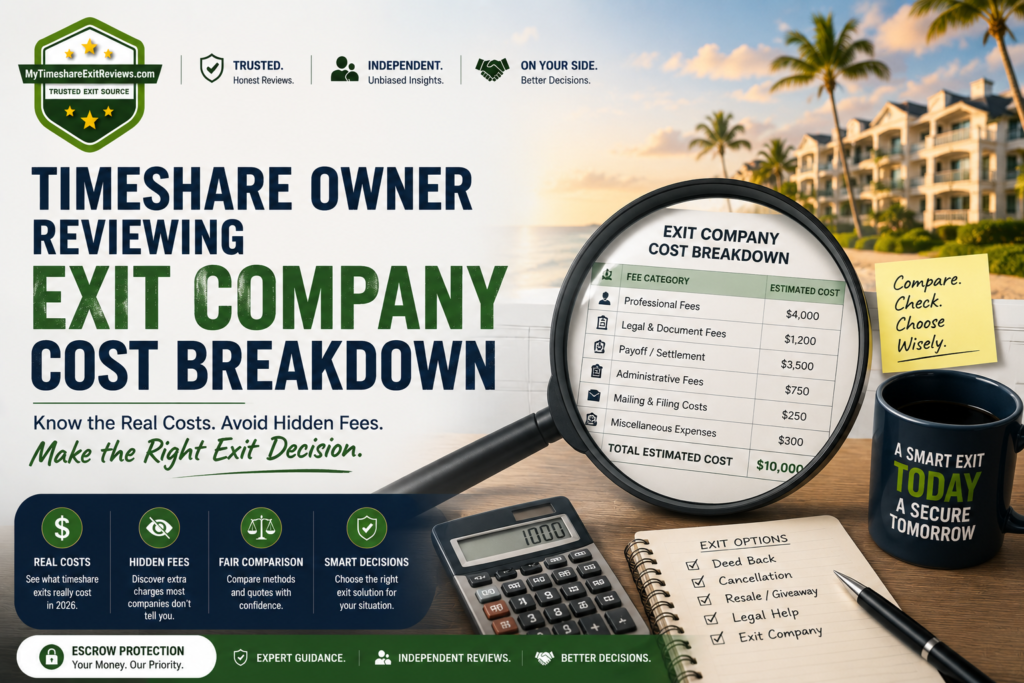
How Much Does a Timeshare Exit Really Cost?
Most owners pay somewhere between $3,000 and $10,000 for a professional timeshare exit in 2026. That’s the honest, unsatisfying answer, because the real number depends on whether you still owe a mortgage on the unit, how many weeks or points you’re trying to cancel, and which fee structure the company you hire actually uses.
Rescission during your state’s cooling off window costs nothing but a stamp. A contested cancellation with a five figure loan balance can run past $15,000. There is no flat industry rate there’s a range, and this guide breaks down exactly where you’re likely to land in it and why.
Timeshare cancellation fees aren’t set the way a mortgage rate or a flight price is set. Nobody publishes a rate card. What we can do is show you what owners in different situations actually paid in 2025 and 2026, so you walk into a consultation knowing what a fair number looks like instead of hearing a quote for the first time with no context.
Why Timeshare Exit Cost Swings So Hard From One Owner to the Next
Five things move the number more than anything else.
Loan status. A paid off week is the cheapest thing in this industry to cancel. A mortgage still attached to the deed means the exit company has to deal with the lender too, and that adds work and price.
Number of contracts. Owners with two or three weeks, or a points package split across several deeds, pay per contract in most fee models. A single week case and a four contract case are not quoted the same way, even at the same company.
Developer. Some brands run internal deed back or surrender programs that cost little to nothing if you qualify. Others fight every cancellation attempt, which pushes owners toward attorneys or exit firms and raises the bill accordingly.
Method chosen. A rescission letter is free. A deed back carries an admin fee. An attorney bills hourly or by retainer. An exit company quotes a flat project rate. Same goal, four very different price tags.
Fee structure. Flat fee, milestone billed, and contingency pricing all land on different numbers for the same case more on that below.
Timeshare Exit Cost by Method: The 2026 Breakdown
| Method | Typical 2026 Cost | Timeline | Best Fit |
|---|---|---|---|
| Rescission (cooling off period) | $0 (certified mail only) | Days | Recent buyers still inside the state rescission window |
| Developer deed back / surrender | $0–$2,000 | 1–6 months | Paid off owners current on fees, if the developer offers one |
| Resale or giveaway | Low fees, near zero return | Months to years | Owners who accept walking away with nothing |
| Attorney led cancellation | $3,000–$7,000 retainer, plus hourly | 6–18 months | Fraud claims, title defects, contested contracts |
| Escrow backed exit company | $3,000–$10,000+ | 9–24 months | Most owners with no live rescission window |
A quick gut check on that table: if a company quotes you under $2,000 for a full contract cancellation and you’re well past rescission, ask exactly which method they’re using. That number usually means deed back eligibility, not a general cancellation service and it’s worth confirming before you assume you found a bargain.
Does a Mortgage Balance Change Your Timeshare Exit Cost?
Yes, and it’s usually the single biggest swing factor after the method itself. A paid off week with no outstanding loan sits at the low end of most quotes, often $3,000 to $5,000 with an escrow backed firm. Add a mortgage, and the company now has to coordinate with the lender, sometimes negotiate a payoff or release, and carry more legal risk if the loan isn’t handled cleanly. Industry pricing patterns we’ve reviewed suggest mortgage cases commonly add $1,500 to $5,000 on top of the paid off baseline, though this varies by lender and loan size.
Multiple contracts stack differently depending on the firm. Some quote a true per contract rate. Others offer a modest bundle discount on the second and third week once the first is under contract. Ask for the itemized breakdown before you sign “one flat fee” that turns out to be three fees added together is a common source of sticker shock later.
The Fee Structures Exit Companies Actually Bill You Under
Four billing models cover almost the entire industry.
Flat fee. One price, quoted upfront, covers the full case regardless of how long it takes. This is the most common structure and, held in escrow, the safest for the owner. Price certainty is the whole point.
Milestone billing. A portion due at signing, a portion at specific case stages, the balance at completion. Reputable firms still hold each installment in escrow until that milestone is verified not just collected on a calendar.
Contingency. No cancellation, no fee. Rare in this industry because it shifts all the risk onto the company, so contingency pricing tends to run higher than flat fee quotes to compensate. Treat a contingency offer that’s priced the same as a flat fee competitor with some skepticism.
Hourly attorney billing. Common for legal routes. Rates typically run $200 to $500 an hour, with total bills depending entirely on how contested the case gets. This structure has the least price certainty of the four.
None of these structures is inherently a scam. What matters is whether the money sits in escrow until milestones are actually met, and whether the terms are in writing before you pay anything.
The Hidden Fees That Turn a $4,000 Quote Into $9,000
The headline number you’re quoted on the phone is rarely the number you end up paying if a company is padding the case. Watch for these add ons showing up after you’ve already signed:
- A “processing” or “administrative” fee tacked on between the verbal quote and the written contract
- “Case complications” fees introduced mid process, often three to six months in, once you’re financially and emotionally invested in finishing
- Unsolicited “credit repair” or “credit monitoring” add-ons bundled into the exit fee
- A “loan negotiation” fee billed separately even though it was implied to be included
- Rush or “expedited processing” charges for a timeline the company already promised at the original price
Every one of these should have been disclosed, in writing, before your first payment. If a company you’re evaluating has a pattern of price increases after signing, that pattern usually shows up in complaint records before it shows up in your own case, check our full breakdown of timeshare exit scams and the 12 warning signs to check first before you pay anything.
Is Your Quote Fair? A Cost vs Value Way to Check
Instead of asking “is $6,000 a lot,” ask what that $6,000 is replacing. Add up your annual maintenance fee, any special assessments from the last two years, and what you’d spend using or not using the unit over the next decade. Average maintenance fees have climbed toward roughly $1,500 a year industry wide, and they tend to rise 5% to 8% annually which means a decade of ownership can easily clear $20,000 before travel costs are even in the picture.
Run that math against the quote in front of you. A $6,000 one time fee that eliminates a $20,000+ ten year obligation is a straightforward trade. A $12,000 quote for a simple, paid off, single week case with no mortgage complications is the kind of number that should make you get a second opinion before signing anything.
Timeshare Cancellation Fees vs. the Cost of Just Staying
Owners tend to compare the exit fee against zero, as if doing nothing costs nothing. It doesn’t. Maintenance fees don’t pause because you’re unsure what to do, and a missed payment doesn’t just disappear .It moves to collections and can sit on your credit for years.
The more useful comparison is exit fee versus total remaining obligation, not exit fee versus a hypothetical zero. Owners who wait an extra two or three years “to be sure” usually end up paying more in fees during that wait than the exit itself would have cost.
When the Price Itself Is the Red Flag
Two pricing patterns deserve extra scrutiny, and they sit at opposite ends of the range.
Too cheap. A flat cancellation quote under $2,000 for a mortgaged, multi contract case, with no mention of deed back eligibility, usually means either the company doesn’t understand your case or isn’t planning to do much work on it.
Too expensive with no escrow. A quote at the high end of the range that also demands full payment upfront, with no third party escrow account, combines the worst of both problems: you’re paying premium pricing with no protection if the company disappears.
Price alone doesn’t tell you whether a company is legitimate the full list of behavioral red flags matters more than the number on the invoice. For the complete rundown, see our 12 red flags for spotting a timeshare exit scam before you commit to any quote.
How to Get an Accurate Timeshare Exit Cost Quote
Five steps before you accept any number:
- Get the quote in writing with every fee itemized not a verbal number over the phone.
- Confirm escrow and ask for documentation showing the account is third party, not company controlled.
- Get two or three quotes so you have a real basis for comparison, not just the first number you heard.
- Ask what specifically is included loan negotiation, deed transfer, court filing fees, all of it before assuming it’s bundled.
- Look up the track record yourself. A BBB profile, a court filing or two, and a couple of independent review threads tell you more than the quotes on their own website ever will.
Our reviews of Wesley Financial Group, Timeshare Compliance, and the rest of our best timeshare cancellation companies list break down real pricing and complaint history by name.
If you’re still early in the process and haven’t picked a method yet, our broader guide on how to get out of a timeshare walks through rescission, deed back, and exit company routes side by side.
Frequently Asked Questions
How much does it cost to cancel a timeshare in 2026?
Most owners pay $3,000 to $10,000 through a professional exit company, with paid off, single contract cases at the low end and mortgaged or multi contract cases at the high end. Rescission during the cooling off period is free, and deed back programs typically run $0 to $2,000 when a developer offers one.
Does timeshare exit cost more if I still owe a mortgage?
Yes. A mortgage balance typically adds to the baseline price because the exit company has to coordinate with the lender and manage more legal risk. Get a written breakdown of exactly what the mortgage related work covers before you sign.
Are there timeshare exit companies with no upfront fees?
Reputable companies place fees in a third party escrow account rather than charging nothing at all the money isn’t released to the company until specific case milestones are met. “No fee unless we succeed” contingency offers exist but are less common and often priced higher to offset the company’s added risk.
Is a $10,000 or higher timeshare cancellation fee normal?
It can be, for a mortgaged case involving multiple contracts or a contested developer relationship. For a paid off single week with no complications, a quote that high is worth a second opinion before you commit.
How do I know if a timeshare exit cost quote is a scam?
Watch for full payment demanded upfront with no escrow, a promised timeline of 30 to 90 days, and fees that increase after you’ve already signed. Any two of these together are enough reason to walk away. See the complete list of warning signs in our scam red flags guide.
Can I negotiate the cost with a timeshare exit company?
Sometimes, especially if you have a competing quote in hand. Ask directly whether the price is flexible and what specifically drives it. A company confident in its pricing will explain the math; one that gets defensive about the question is a signal worth noting.
What’s the cheapest legitimate way to exit a timeshare?
Rescission is free if you’re still inside your state’s cooling off window. After that, a developer deed back program is usually the next cheapest option if your unit qualifies and you’re current on payments.