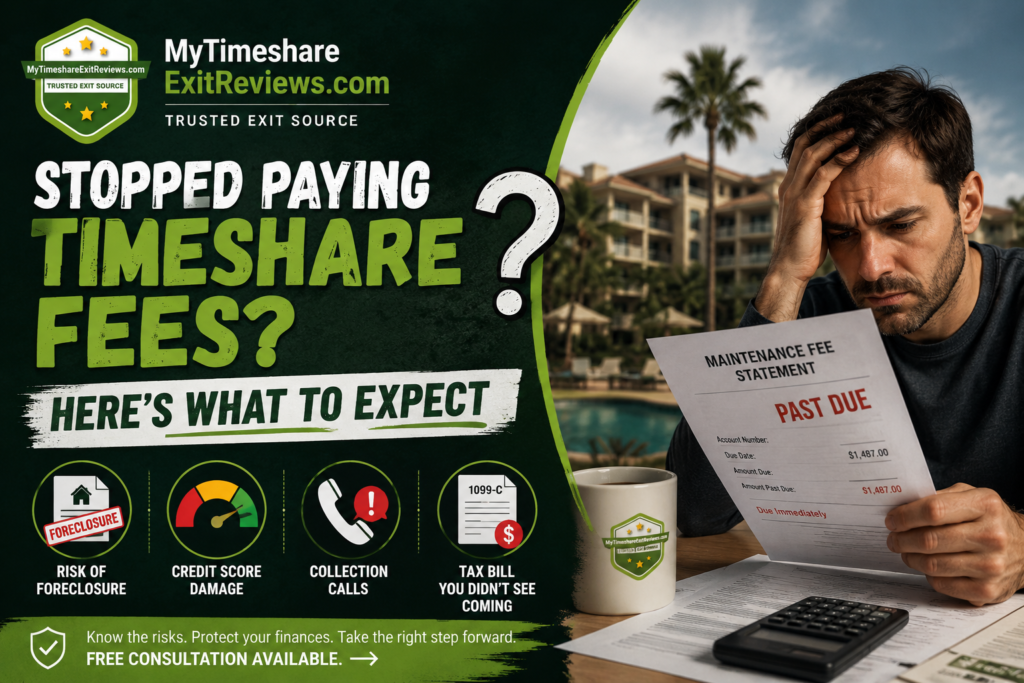
Stop paying your timeshare maintenance fees, and the resort doesn’t just let it slide. Within a few months, most owners are dealing with collection calls, a damaged credit file, and if the ownership is deeded, a real foreclosure that can leave you owing money even after the property is gone
That’s the short version. The consequences of not paying timeshare fees range from a late notice to a full foreclosure, and where you land on that scale depends on your ownership type, your state, and how many payments you’ve already missed.
If a fee increase is what pushed you here, you’re not alone. Industry data from ARDA puts the average U.S. maintenance fee at $1,480 per interval in 2024, up from $1,260 the year before — a 17.5% jump in a single year. For a lot of owners, that kind of increase is what turns “I’ll figure it out” into “what actually happens if I just stop?”
What Happens the Moment You Miss a Payment
The first 30 days are quiet. You’ll get a late notice, maybe a phone call, and a late fee added to your balance, typically somewhere between $25 and $150 depending on the resort’s fee schedule.
Past 60 days, most management companies cut off your usage rights. You can’t book your week or redeem points, even with a confirmation number from years ago. The account status shifts from “past due” to “delinquent,” and that shift matters, because delinquent accounts are what get handed to collections or legal departments.
By 90 to 120 days, expect one of two things: a collections agency now owns the conversation, or the resort’s attorney sends a formal Notice of Default. Some resorts move faster than that. Others, especially smaller independent properties without in-house legal teams, will let an account sit for a year before acting. There’s no universal timeline here — the default and remedies section of your own contract is the only reliable answer for your situation.
| Days Past Due | What Usually Happens |
|---|---|
| 0–30 | Late notice, late fee added to the balance, possible phone contact |
| 30–60 | Usage rights suspended — no booking, no check-in, no points redemption |
| 60–90 | Account marked delinquent; may move to internal legal review |
| 90–120+ | Referred to a collections agency, or a formal Notice of Default is issued |
| 120+ | Lien filed; foreclosure or further legal action becomes possible depending on ownership type |
Timeshare Default: What the Term Actually Means
Timeshare default simply means you’ve broken the payment terms in your contract. It’s the same idea as defaulting on a mortgage or a car loan, except most owners have never actually read the clause that defines it for their specific ownership.
Look for language like “event of default” or “remedies upon default” in your purchase agreement, or in the resort’s Declaration of Covenants, Conditions, and Restrictions — usually shortened to the CC&Rs. That section spells out what triggers default, what the resort is allowed to do about it, and whether there’s a grace period before penalties kick in.
Two things catch owners off guard almost every time they read this section for the first time. First, default can happen even after your original purchase loan is fully paid off, because maintenance fees are a separate obligation from the purchase financing. Second, most contracts don’t require the resort to send you individual notice beyond what’s already spelled out in the recorded CC&Rs — documents you technically agreed to the day you signed.
Deeded vs. Right-to-Use: Why Ownership Type Changes Everything
Your ownership structure decides whether foreclosure is even on the table. Deeded timeshares are real property, recorded at the county level, which means the resort can file a lien and pursue foreclosure the same way a mortgage lender would. Right-to-use and points-based memberships are contract rights, not property, so instead of a foreclosure, the resort typically cancels the membership and pursues the unpaid balance as a straightforward debt.
| Ownership Type | What Default Leads To |
|---|---|
| Deeded (fee simple) | Lien on the property → possible foreclosure → possible deficiency judgment for any remaining balance |
| Right-to-use / points-based | Contract termination → collections → possible lawsuit for the balance, but no property lien |
Neither path is more forgiving. They just create different kinds of exposure. A points-based owner won’t face foreclosure, but they can still be sued for the outstanding balance, and a resulting judgment can lead to wage garnishment or a bank levy depending on state law.
Collections and the Hit to Your Credit
An unpaid timeshare account eventually behaves like any other unpaid debt: it gets reported. A collections account or a foreclosure entry can sit on your credit report for up to seven years, and during that window it can affect your ability to qualify for a mortgage, refinance, or pass a credit check for certain jobs.
Debt collectors calling about a timeshare balance are still bound by the Fair Debt Collection Practices Act. They can contact you, report the account, and try to negotiate a settlement. They can’t threaten you, misrepresent the debt, or call outside the hours the law allows. The Consumer Financial Protection Bureau publishes a plain-language breakdown of those rights if a collector’s tactics start to feel like harassment.
Not every resort reports to the credit bureaus the same way. Some are aggressive about it from the first missed payment. Others rely almost entirely on internal collections and only escalate to a bureau-reporting agency once the account is seriously delinquent — worth knowing before you assume every resort handles this identically. For a longer look at how this plays out over time, see how timeshares can hurt your credit.
Can a Resort Actually Foreclose on a Timeshare?
Yes — if the ownership is deeded and the account is far enough behind, foreclosure is a real and fairly common outcome. It doesn’t require an outstanding purchase loan. Unpaid maintenance fees alone are enough to trigger it under most CC&Rs.
Judicial vs. Non-Judicial Foreclosure
Judicial foreclosure runs through the court system. It’s slower, and it gives the owner more chances to respond or negotiate along the way. Non-judicial foreclosure skips the courtroom entirely when the contract includes a power-of-sale clause, which most timeshare declarations do. That version typically follows three steps: a Notice of Default, a Notice of Sale, and then a public auction of the interest. Depending on the state, the whole process can wrap up in a few months.
Deficiency Judgments: The Debt That Doesn’t End at Foreclosure
Foreclosure doesn’t automatically erase what you owe. If the auction sale price doesn’t cover the outstanding balance, late fees, and legal costs, the resort can pursue a deficiency judgment for the difference. Say an owner owes
$9,000 when the account goes to foreclosure and the interest sells at auction for $2,500 — the resort can go after the remaining roughly $6,500 through a separate collection action, on top of having already lost the timeshare.
Whether a deficiency judgment actually gets pursued depends heavily on the resort and the state. Some developers write it off as a cost of doing business. Others, particularly larger branded resorts with in-house legal teams, pursue it as standard policy.
The Tax Bill Nobody Mentions, Form 1099-C
Here’s the part almost no one sees coming. If the resort forgives any remaining debt after foreclosure, that forgiven amount can be reported to the IRS as income on Form 1099-C, and you may owe taxes on it the following spring.
The mechanics, if you owed $16,000 and the resort writes off $12,000 of it after recovering the rest through the foreclosure sale, that $12,000 typically shows up as “other income” on your tax return unless an exclusion applies. The most common exclusion is the insolvency exclusion under IRC Section 108, which lets you exclude canceled debt up to the amount by which your liabilities exceeded your assets right before the cancellation. Claiming it requires filing Form 982 and working through the insolvency math correctly, which isn’t a do-it-yourself project for most people.
This isn’t tax advice, and the right move depends on your full financial picture. A CPA or tax attorney should review the actual 1099-C before you file anything.
Why the Fees Keep Climbing in the First Place
Part of what pushes owners toward default is the fee itself, which rarely moves in the owner’s favor. Resorts fund maintenance fees through the HOA or management company, and increases typically land somewhere between 5% and 10% a year, well ahead of general inflation.
There’s also a less obvious mechanic at work. When enough owners default, stop paying, or simply disappear, the resort still has a budget to fund. That shortfall often gets redistributed across the remaining owners as higher fees or special assessments. In other words, owners who stay current are, in effect, subsidizing the ones who leave, which is one reason resorts have gotten more aggressive about pursuing delinquent accounts instead of writing them off quietly.
Does Stopping Payment Actually Solve Anything?
For most owners, no. It trades one problem for a bigger one. Walking away doesn’t cancel a contract; it just changes which department is chasing you and adds late fees, collection costs, and potential legal exposure on top of the original balance. Our full breakdown of walking away from timeshare maintenance fees covers a few more angles on this if you want a second read.
This matters even more because some so-called exit companies tell clients to simply stop paying while the “exit process” runs in the background. That advice can be the entire strategy being sold, and it’s a major reason the timeshare exit industry has a scam problem worth researching before hiring anyone. If a company’s plan for getting you out involves defaulting first, ask exactly what happens to your credit and your legal exposure while that plays out, and get the answer in writing.
Perpetuity Clauses: Could Your Family Inherit This?
Many timeshare contracts are written as perpetuity agreements, meaning the ownership obligation doesn’t expire on a set term. It continues until it’s formally transferred, surrendered, or otherwise resolved, which is part of why some owners describe timeshares as debts that outlive the original buyer.
Heirs generally aren’t personally liable for a deceased owner’s timeshare balance unless they co-signed the original contract or the loan. What they can inherit is the property or membership itself, along with the obligation to keep paying if they want to keep it. An estate can typically disclaim or refuse the ownership through probate, but the process varies by state and by the specific contract language, so it’s worth reviewing with an estate attorney rather than assuming it resolves itself.
Safer Ways to Get Out Before It Gets This Far
Stopping payment isn’t the only lever available, and it’s rarely the best one. A few options are worth exhausting first.
- Call the resort directly and ask about hardship programs, deed-back options, or a voluntary surrender. Some developers have formal programs for exactly this situation, and it costs nothing to ask.
- Look into resale or transfer if the ownership is paid off and transfer-eligible, keeping in mind resale value is usually far lower than the original purchase price.
- Get a second opinion from a properly vetted exit company rather than the first one that calls you. Reviews of companies like Timeshare Compliance and Wesley Financial Group, along with our roundup of the best timeshare cancellation companies, are a good starting point for comparison.
- Read the fine print in any exit company’s own contract before signing, especially any clause about how they expect you to handle maintenance fees during the process.
If your situation involves a specific developer, our full guide on how to get out of a timeshare in 2026 covers rescission windows, deed-back programs, and realistic timelines in more depth. Every developer handles default a little differently, too. If your ownership is with a specific brand, brand-level guidance can fill in gaps this overview can’t cover, including our pages on Holiday Inn Club Vacations cancellation and Vacation Village timeshare cancellation.
For a broader starting point on any of this, our timeshare cancellation hub rounds up the full range of exit strategies in one place.
Frequently Asked Questions
What happens if I stop paying my timeshare maintenance fees?
Expect late fees within the first month, suspended usage rights within about 60 days, and referral to collections or legal review within 90 to 120 days. If the ownership is deeded, foreclosure becomes possible after that, along with a potential deficiency judgment for any remaining balance.
Is timeshare default the same as timeshare foreclosure?
No. Default just means you’ve fallen behind and broken the terms you signed. Foreclosure is only one thing that can follow it, and it only applies to deeded ownership. If your timeshare is right-to-use or points-based, default leads to contract termination and collections instead, not foreclosure.
Can a timeshare foreclosure hurt my credit score?
Yes. Once it hits your credit report, a timeshare foreclosure or collections account can stick around for up to seven years — long enough to make it harder to get approved for a mortgage, a car loan, or even a new credit card.
Will I owe taxes if my timeshare debt gets canceled?
Possibly. When a lender cancels debt and reports it on Form 1099-C, the IRS usually counts that amount as income, unless you qualify for an exclusion like the insolvency exclusion on Form 982. Have a tax professional look at your actual 1099-C before you assume either way.
Do my heirs inherit my timeshare maintenance fees?
Not personally, in most cases, unless they co-signed the contract. They can inherit the ownership itself and the obligation to keep paying if they choose to keep it, and an estate can typically disclaim the ownership through probate.
What should I do instead of just stopping payment?
Contact the resort about hardship or deed-back programs first, since that costs nothing and some developers offer it. If that doesn’t resolve things, compare vetted exit options and read any company’s own contract carefully before paying anyone.
Flags Summary
- ARDA 2024 average maintenance fee figure ($1,480 / $1,260, 17.5% YoY) — confirm against latest ARDA State of the Industry report before publish.
- Late fee dollar range ($25–$150) — generic industry range, not resort-specific; adjust if this page ever gets localized to one developer.
- 7-year credit reporting window — standard FCRA-aligned figure, confirm no recent change.
- Deficiency judgment and 1099-C dollar figures are made-up examples to show the math, not real cases — kept that way on purpose so nothing here reads like a promised outcome.
- Wage garnishment / bank levy and heir-liability statements — both are state-dependent; recommend legal disclaimer language consistent with the rest of the site’s disclaimer page.
- 5–10% annual fee increase range — confirm against current-year ARDA/industry data before publish.